By the time we reach Mount Carmel, centuries have passed.
The people Moses led had crossed the Jordan, taken possession of the land, and seen the promises of God fulfilled. Kings had risen and fallen. The kingdom had flourished and then divided. What began at Sinai as a holy nation, over time, became a people torn between allegiance to God and the pull of surrounding cultures.
It was into this spiritual decline that Elijah came, and it was on Mount Carmel that the question of the nation’s loyalty was brought to a decisive moment.
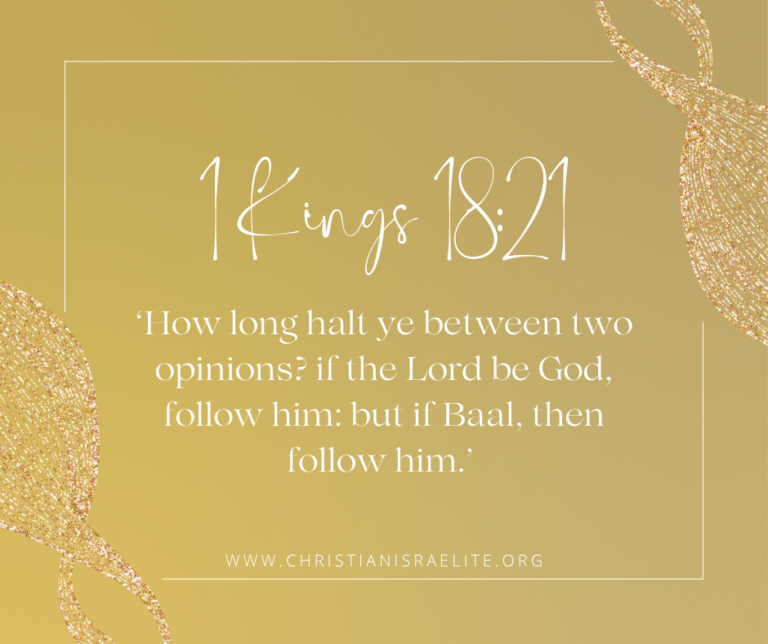
‘And Elijah came unto all the people, and said, How long halt ye between two opinions? if the Lord be God, follow him: but if Baal, then follow him.’ 1 Kings 18:21.
On Sinai, God revealed who he was, but Carmel became the mount where the people had to decide how they would respond to him.
By this time, a drought had gripped the land for years, giving rise to a direct confrontation between the Lord and Baal, the supposed god of rain and fertility. Elijah called the people, along with the prophets of Baal, to the top of Carmel for a public test.
Two altars were prepared and two sacrifices were laid. But no fire was to be kindled by human hand:
‘The God that answereth by fire, let him be God.’ 1 Kings 18:24.
The prophets of Baal cried out from morning until evening, but there was no voice, no answer, no power. Elijah suggested they cried louder—perhaps their god was asleep or away on a journey and couldn’t hear them (1 Kings 18:27). They cut themselves until blood gushed out in a plea to Baal, but still their altar remained cold and silent.
Elijah rebuilt the altar of the Lord and drenched the sacrifice with water until it overflowed into the trench around it. And then, with a brief and direct prayer, he called upon the God of Israel:
‘Lord God of Abraham, Isaac, and of Israel, let it be known this day that thou art God in Israel… Hear me, O Lord, hear me, that this people may know that thou art the Lord God, and that thou hast turned their heart back again.’ 1 Kings 18:36–37.
Fire immediately followed, consuming the sacrifice, the wood—even the water. What Baal could not do after hours of desperate effort, the Lord accomplished in a moment.
When the people witnessed it, they fell on their faces and declared:
‘The Lord, he is the God; the Lord, he is the God.’ 1 Kings 18:39.
Mount Carmel teaches us that faith cannot remain neutral. There are moments when God brings us to a place of clarity, where indecision is no longer possible and we are called to choose whom we will serve. In fact, Carmel reminds us that delay is itself a decision; refusing to choose is, in effect, to choose against God.
Elijah’s challenge still echoes into today’s world: ‘How long halt ye between two opinions?’
It also reveals that God is not silent or distant in these moments. Just as he answered by fire on Carmel, he makes himself known today with unmistakable clarity, calling his people back to himself.
Centuries earlier, at Sinai, God declared Israel to be a holy nation set apart for him. On Carmel, that calling is brought back into focus.
Next, we ascend the mountain where the same God reveals not his power in judgment, but his glory in the person of his Son.